Best Slovenian meat products
The pride of local producers
Slovenian cold cuts are full of delicacies that our ancestors produced and enjoyed in our territory in the past.
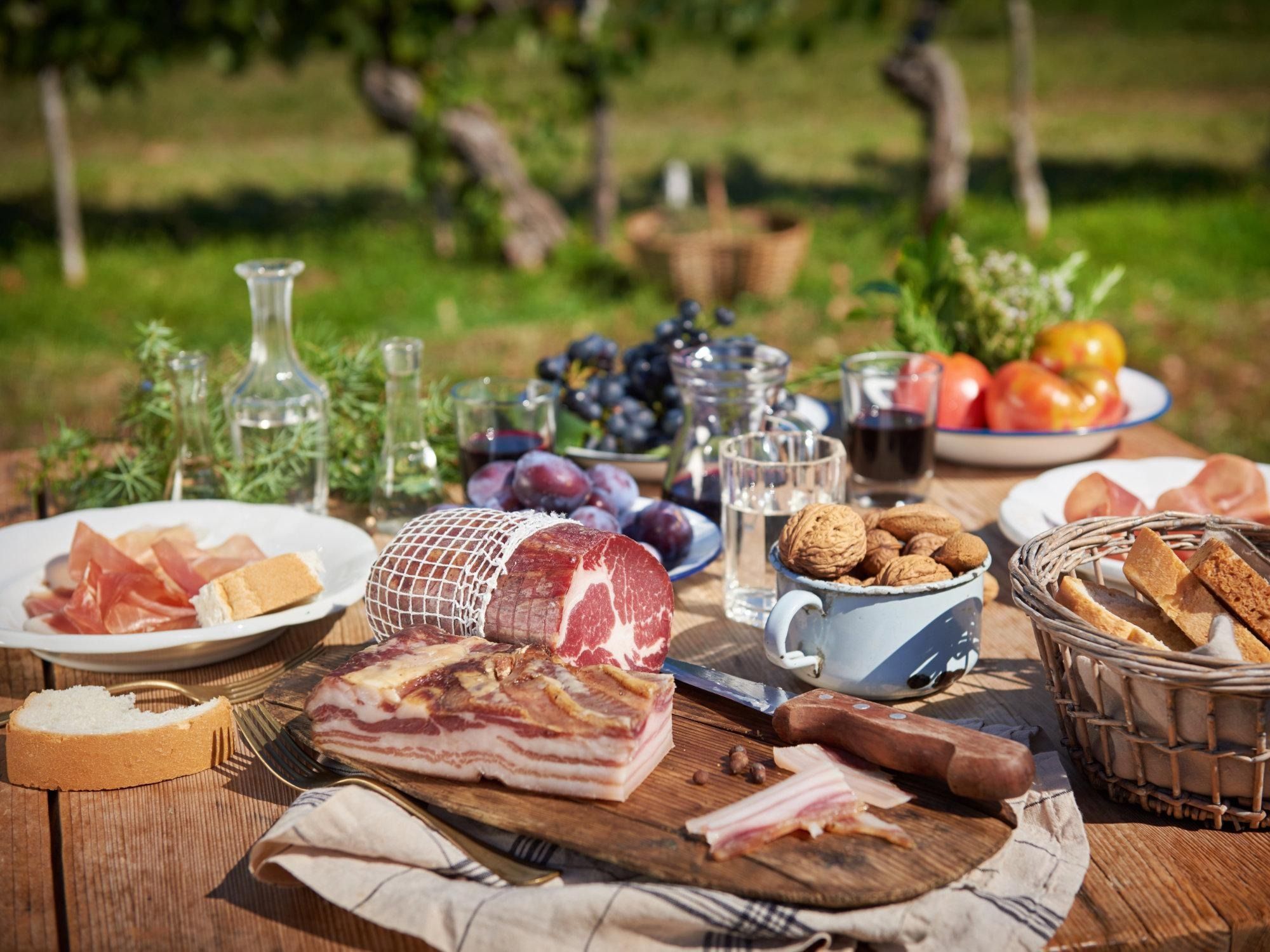
In various corners of Slovenia, you can find excellent meat products that are the pride of local producers. From the most famous Kranjska sausage to Istrian and Karst prosciutto, the Upper Savinja Valley and Šebrelje želodec (stuffed pig stomach), Prekmurje ham and Karst zašink (pork neck) and pancetta. These are but a few of the most famous meat delicacies with protected designation of origin and protected geographical indication certificates. Almost everywhere in the country, it is possible to find an array of excellent salamis and sausages, blood sausages, lard, braciolas and more. Pork, beef or venison are used most frequently, but occasionally also bear, wild boar or chamois.
As many as eight different traditional meat products are equipped with the protected geographical indication label. The food quality scheme includes agricultural produce and foodstuffs that originate from a particular location, region or country. Such foodstuffs have a special quality, reputation or other characteristics, and must come from a designated geographical area.
Karst meat products
Photo: Tomo Jesenični
Delicious skewered meat product since 1896
One of the most distinctive Slovenian products is Kranjska sausage. It is based on the rich heritage of processing pork into meat products. The oldest mention of this sausage, calling it ‘kranjska klobasa’, dates back to 1896. A former region of Kranjska/Carniola still existed then. It was a historical region from the time of the former Austro-Hungarian Empire.
Kranjska sausage is a pasteurised semi-durable sausage made from coarsely minced pork and bacon from neck, back or leg. The filling is seasoned with garlic and pepper and skewered with a wooden dowel. The sausage undergoes hot smoking. It is eaten warm after being briefly heated in hot water, acquiring its specific organoleptic characteristics and high gastronomic quality. The economic interest group, GIZ Kranjska klobasa, combines producers of these sausages. The best sausage is selected at the annual Kranjska Klobasa Festival.
Kranjska sausage
Photo: Tomo Jeseničnik
Karst is a paradise for meat lovers
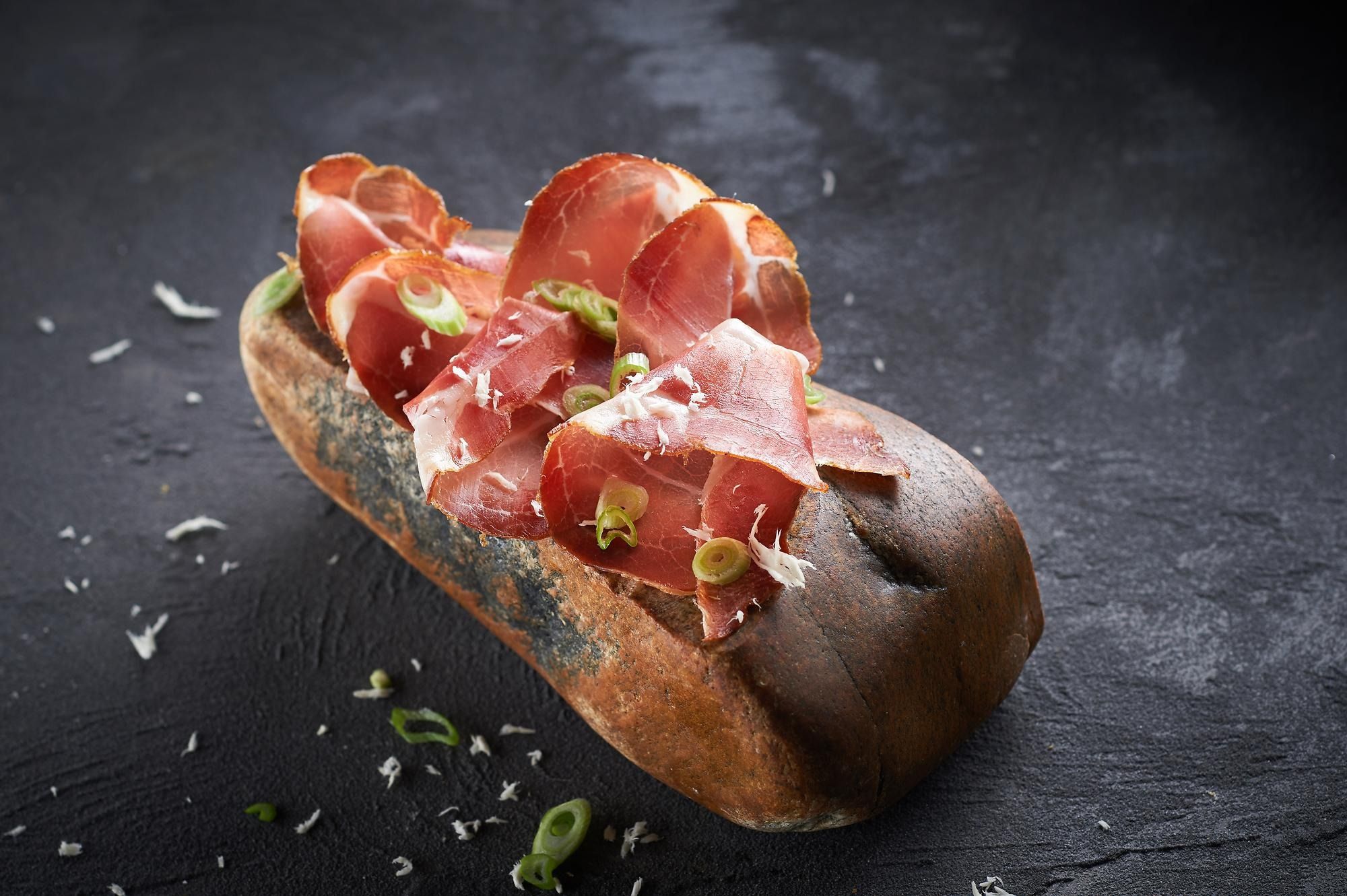
In the south-western corner of Slovenia, the Karst plateau is celebrated for excellent cured meat products. Karst prosciutto is the result of a several hundred years old tradition of salting and air drying of pork meat. Only two additives are permitted: coarse sea salt and Karst air. Karst prosciutto would not be possible without the bora, the gusty wind that dries the meat, which is matured for about one year.
Karst zašink is made from pork neck without bones. It has a typical cylindrical shape and a natural casing covered by elastic netting. The full aroma and flavour of muscle meat and bacon with a slightly salty taste develop during the drying and maturing process.
Lean bacon is dried in the Karst into delicious pancetta that is included in the offer of cured Karst meat products and is indispensable when preparing certain dishes. A thin slice of Karst pancetta is distinguished by an intensive red colour of matured muscle meat and creamy white bacon. It has full aroma and tender structure.
Karst prosciutto
Photo: STO
Karst zašink
Photo: STO
Karst pancetta
Photo: STO
01/03
Delicacies from the East
Prleška tünka is made of minced lard and pork from leg, back, loin or neck. The meat is cured with salt before undergoing dry heat treatment and smoking. The meat and minced lard are then placed (tünkati; dipped) in alternate layers into a vessel where they mature for at least one month. The wooden vessel is called a tünka. The oldest mention of Prleška tünka is from 1487. Farmers used this method to preserve meat before the invention of the refrigerator.
Prleška tünka
Photo: Tomo Jeseničnik
Prekmurje ham is also very famous. Cured meat from the pear-shaped hind leg of pork without bones and with bacon is processed in a traditional manner. The suitably chilled leg is salted and seasoned. Prior to smoking, excess salt is removed from the ham, which is then matured for another six months. Favourable climate conditions are required for successful maturing, i.e. dry and harsh winters.
Production of a number of very traditional meat products is still alive in Prekmurje, for example, sausages with buckwheat and millet porridge, brawn, baked blood and others. Zasavje liver sausage can be served warm or cold. This is a typical semi-durable sausage with liver filling made in the Zasavje region at the time of pig slaughtering. Wheat sausage is called jeglača or mastnica in Bela Krajina and is stuffed with millet porridge and meat.
Prekmurje ham
Photo: Tomo Jeseničnik
Round stomachs
Meat products stuffed in pig stomachs have special shapes. Zgornjesavinjski želodec made in the Upper Savinja Valley is a top cured meat product made from high-quality pork and bacon.
In the Šebrelje Plateau, special climate conditions enrich the protected šebreljski želodec. Pig stomach (želodec) is stuffed with the best cut of pork and some bacon, and it then matures between two wooden plates.
In the Pohorje Hills, the pohorska bunka is made from the best pork, which is put in a pig stomach or bovine large intestine, smoked and then air dried. Danka or stomach with millet porridge is made in the Gorenjska region. Stomach or pig’s large intestine stuffed with meat, millet porridge and spices, which are then mildly smoked, are delicious products made when pigs are slaughtered. Cut into rings, it can be served warm or cold once it is cooked.
Čmar, made at the time of pig slaughtering in Bela Krajina, is also a type of stuffed pig stomach.
Pohorska bunka
Photo: Domen Groegl
And many more!
Wether Tržič braciolas are traditionally made at the Tržič Braciola Festival in the Gorenjska region. The Goriška region is known for mulce, Goriška blood sausages that are stuffed with corn flour, pork blood, raisins, sugar and spices. Before the dish is served, it is cooked, cut into rings and fried in a pan. There are also Goriška pork sausages baked in wine, krodegine (pork skin sausages), šankanele (blood sausages) and markandele (pig offal sausages) from the Goriška Brda Hills.
In addition to all the products mentioned above, many producers make their own delicious traditional cured meat products that are offered at their tourist farms. One of the more known producers is the BioSing company, a top boutique meat producer that uses the best quality meat and processes it in accordance with traditional procedures. They produce boutique organic cured meat products for people who value great taste as their products are additive-free and are meant for tasting and combining with supreme wines.
Novaške krvavice
Photo: STO
Goriške pečenice
Photo: STO
Tržiška bržola
Photo: STO
01/03
Only a few decades ago, pig slaughtering was one of the greatest holidays in the Slovenian countryside. It lasted several days, and work started before the day the pig was slaughtered. Processing of an animal into various meat products is a true ritual even today. In the past, nothing went to waste, as the entire animal was used, and this sustainability-oriented philosophy is making a comeback. Particularities typical of places and regions developed over the centuries when selecting, seasoning and preparing meat. This resulted in a broad array of Slovenian meat products.