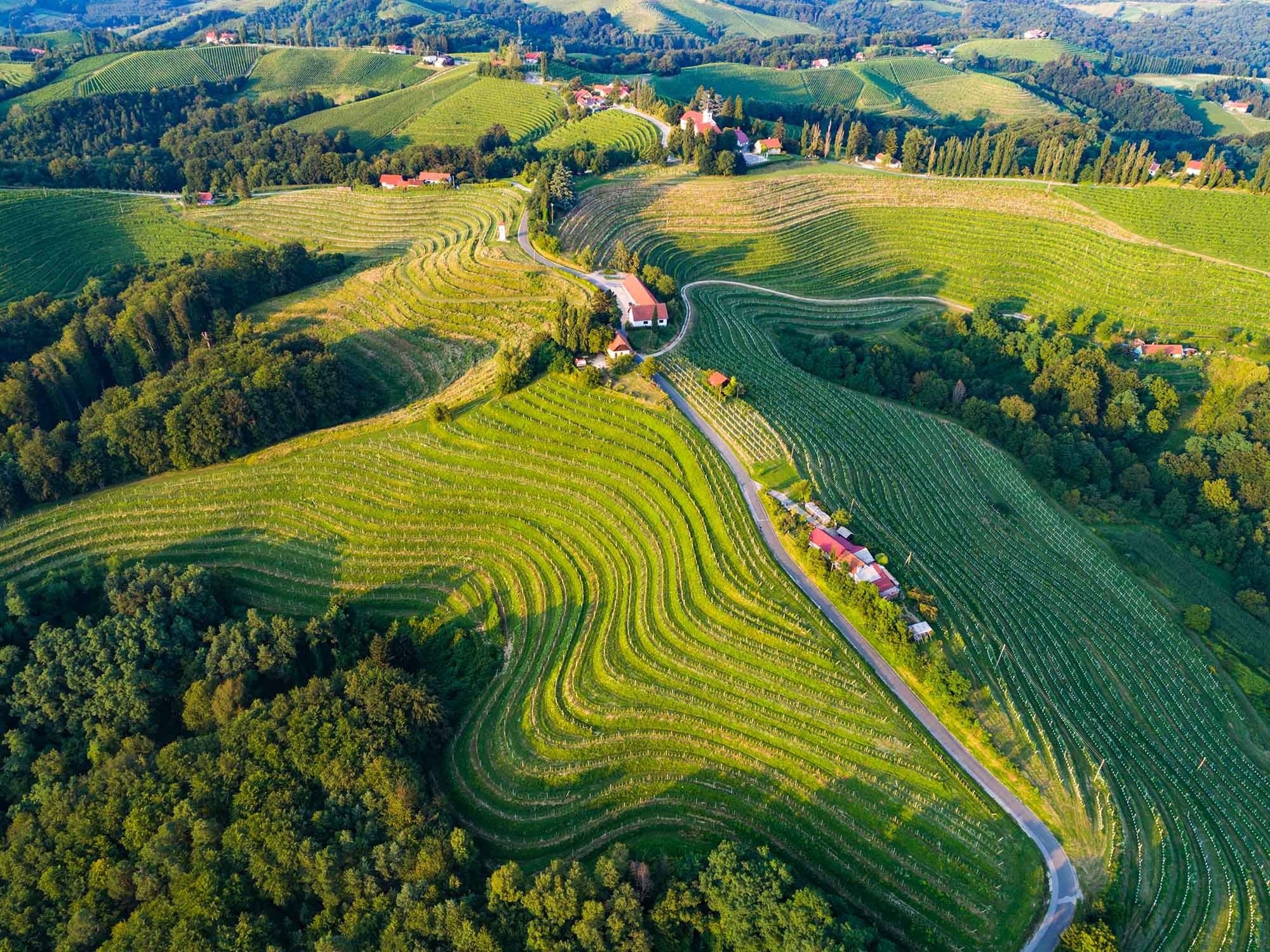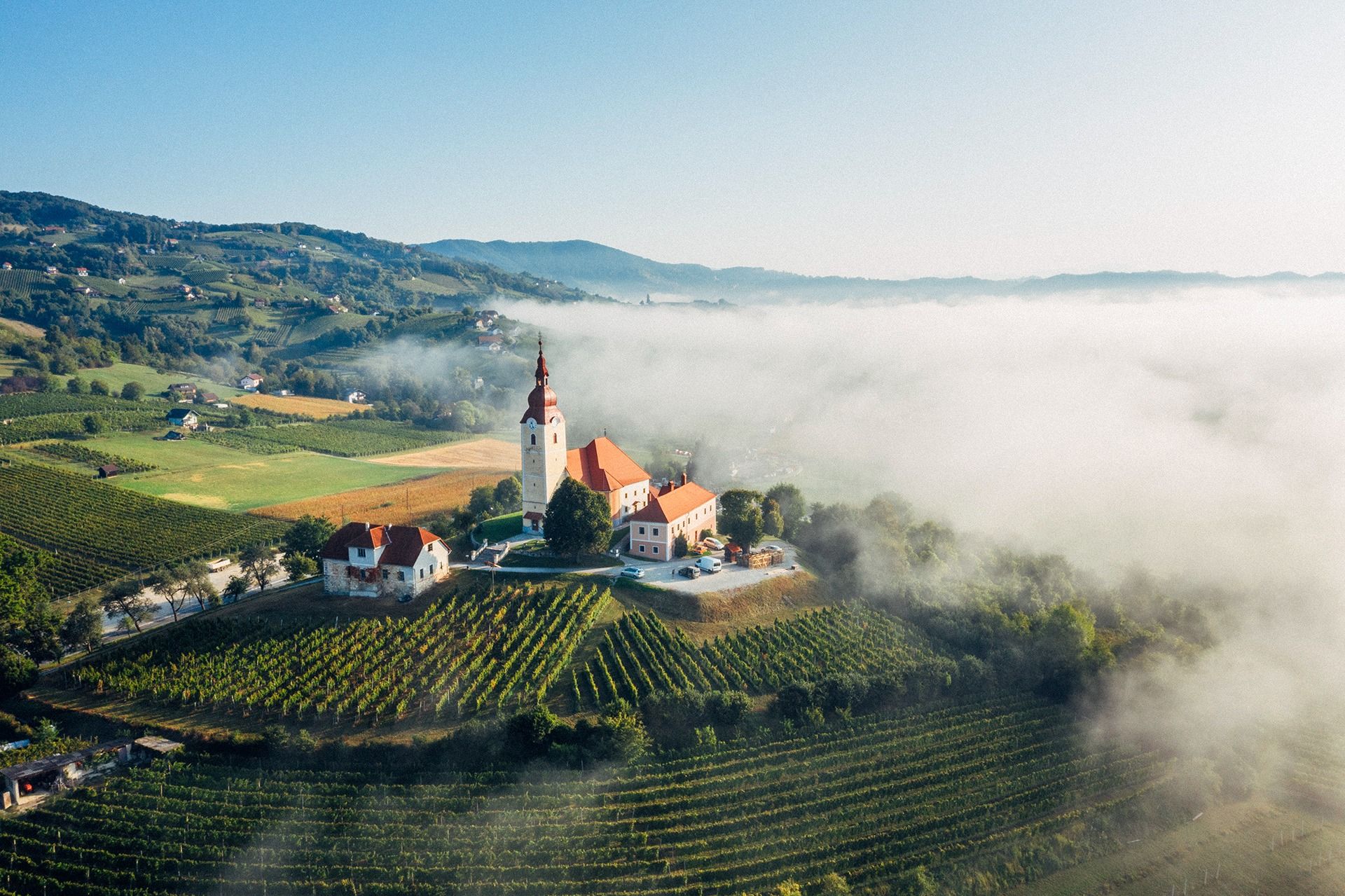
Primorska wine-growing region
Primorska is the warmest wine-growing region
Its popularity grew rapidly immediately after 1991 when Slovenia became independent, and has continued to grow ever since.
All four wine-growing districts in Primorska – Brda, Vipavska dolina (the Vipava Valley), Kras (the Karst), and Slovenska Istra (Slovenian Istria) can feel the greater or lesser influence of the Mediterranean.
Goriška brda
Photo: Tomo Jeseničnik
Brda wine-growing district
Halfway between the Alps and the Mediterranean.
Primorska is the warmest wine-growing region in Slovenia, and also the most popular among wine lovers. If you climb the Gonjače view tower in nice weather, you will experience one of the most magnificent wine views on the planet. Brda at your fingertips, the glitter of the Gulf of Trieste in the south, snow-capped Alpine peaks in the north-west. The Brda wine-growing district enjoys the influence of both the Alps and the Mediterranean, making wines full bodied but lively and ageworthy. Brda winemakers might have built their reputation with superb white wines based on Chardonnay and Rebula, and red wines based on Merlot and Cabernet Sauvignon, but recently more attention is drawn to its majesty – Rebula. Winemakers compete to find out who will get the most from the seemingly modest wine. And believe me, only the sky is the limit. Try a glass of top Rebula – the flavour, the scent … An experience you will remember for a long time to come.
Let us tell you that although Brda is a warm district, its winemakers produce amazing sparkling wines.
Vipavska dolina (Vipava Valley) wine-growing district
“We feel the Mediterranean, although we cannot see it."
At the moment, the Vipava Valley is the most dynamic wine-growing district in Slovenia. And that’s that. Merlot and Sauvignon Blanc might be the most widespread varieties with good, even excellent, results, but slightly more adventurous winemakers have gone back to old varieties which have been in the Vipava Valley for centuries: Rebula, Istrian Malvasia, Pinela, indigenous Zelén, and even Welschriesling. They have been rediscovering their properties and placing them to unseen blends. The Vipava Valley is gaining its own completely new, authentic image unparalleled in the world. There is also the aromatic, spicy Zelén which only grows in the Vipava Valley.
This valley extends between the cold Trnovski gozd in the north and the Karst in the south. For centuries, it has been known for wine and fruit production, particularly the production of peaches, apricots, and cherries. In the west, the valley opens towards the Mediterranean Sea, and its influence, which is manifested in the shape of olive trees, bay laurel, and persimmon, stretches deep into the valley.
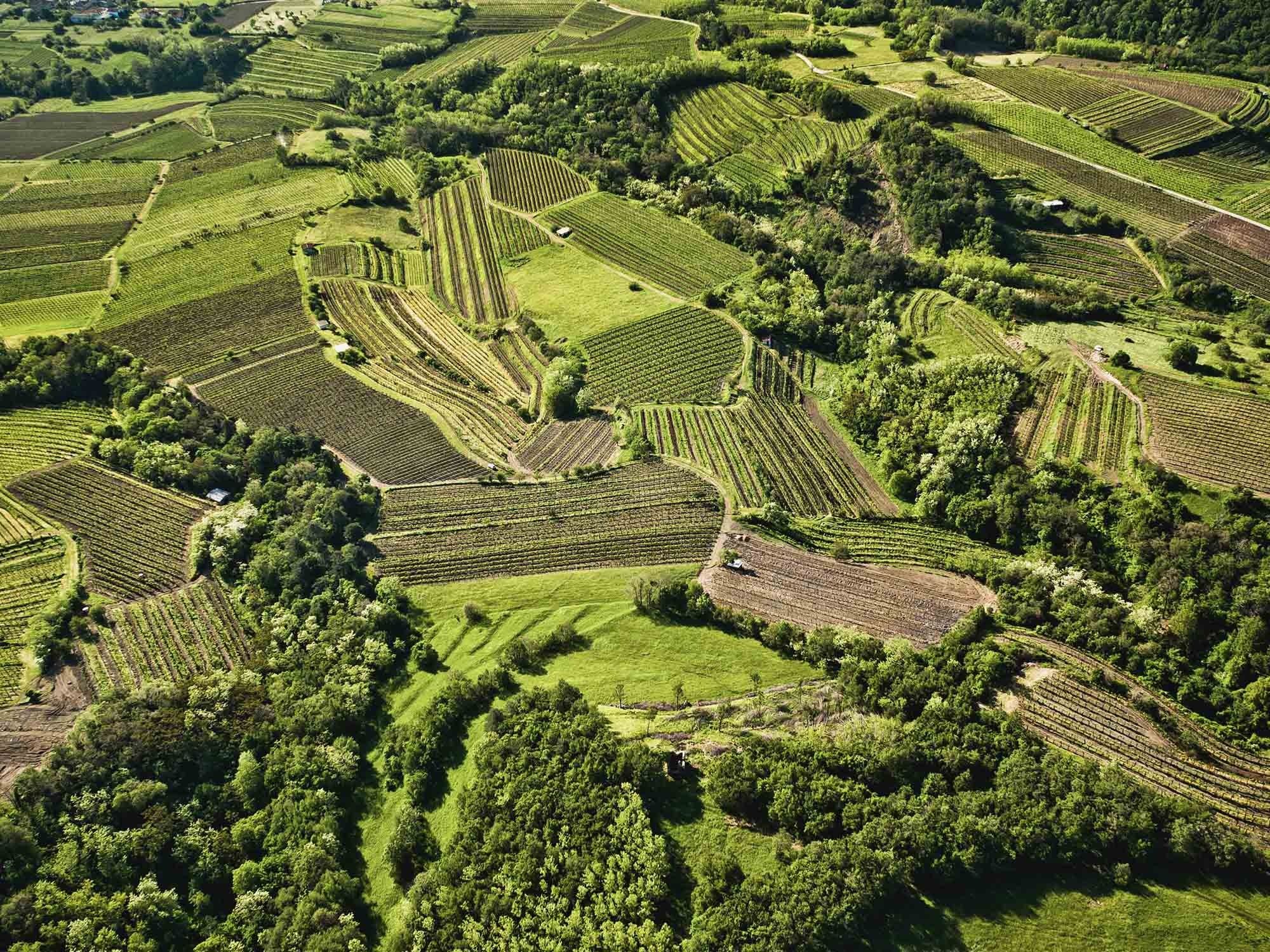
Vipava Valley
Photo: Nea Culpa d.o.o.
Kras (Karst) wine-growing district
It is perfectly possible that wines from the Karst were praised as far back as the time of Pliny the Elder (AD 23–79).
In his records, Pliny attributed the venerable age of Julia Augusta (Livia Drusilla), the wife of Emperor Augustus, to the fact that she drank the wine of Pucinia.
With 578 hectares of vineyards, the Karst wine-growing district is the smallest district in Primorska. Vineyards stretch on the limestone Karst plateau at altitudes between 200 and 400 m. The typical Karst soil is red (terra rossa) rich in iron oxides.
The Karst is located between the Adriatic Sea and the easternmost part of the Alps. Its climate is a combination of continental and sub-Mediterranean climate with clear Alpine influences. The consequences of its position are a cold and dry wind, the bora, which blows from the continent, and high precipitation, which is unusual for a wine-growing region, which, however, does not pose a problem due to the favourable annual distribution of precipitation and permeable soil. The traditional training system, the Karst trellis (pergola), which is known particularly for good yield, has largely been replaced by the guyot growing structure, which has brought higher quality.
In the Karst, Teran is the king of wines, produced from the red variety of Refošk, and takes up three quarters of all vineyards. Teran is a wine ruby red in colour with shades of violet, moderate or lower in alcohol, and highly acidic. It is also characterised by red berry flavours. Istrian Malvasia and indigenous Vitovska Grganja, stand out among white varieties.
Karst vineyard
Photo: Iztok Medja
Slovenska Istra (Slovenian Istria) wine-growing district
Where vineyards look at the sea.
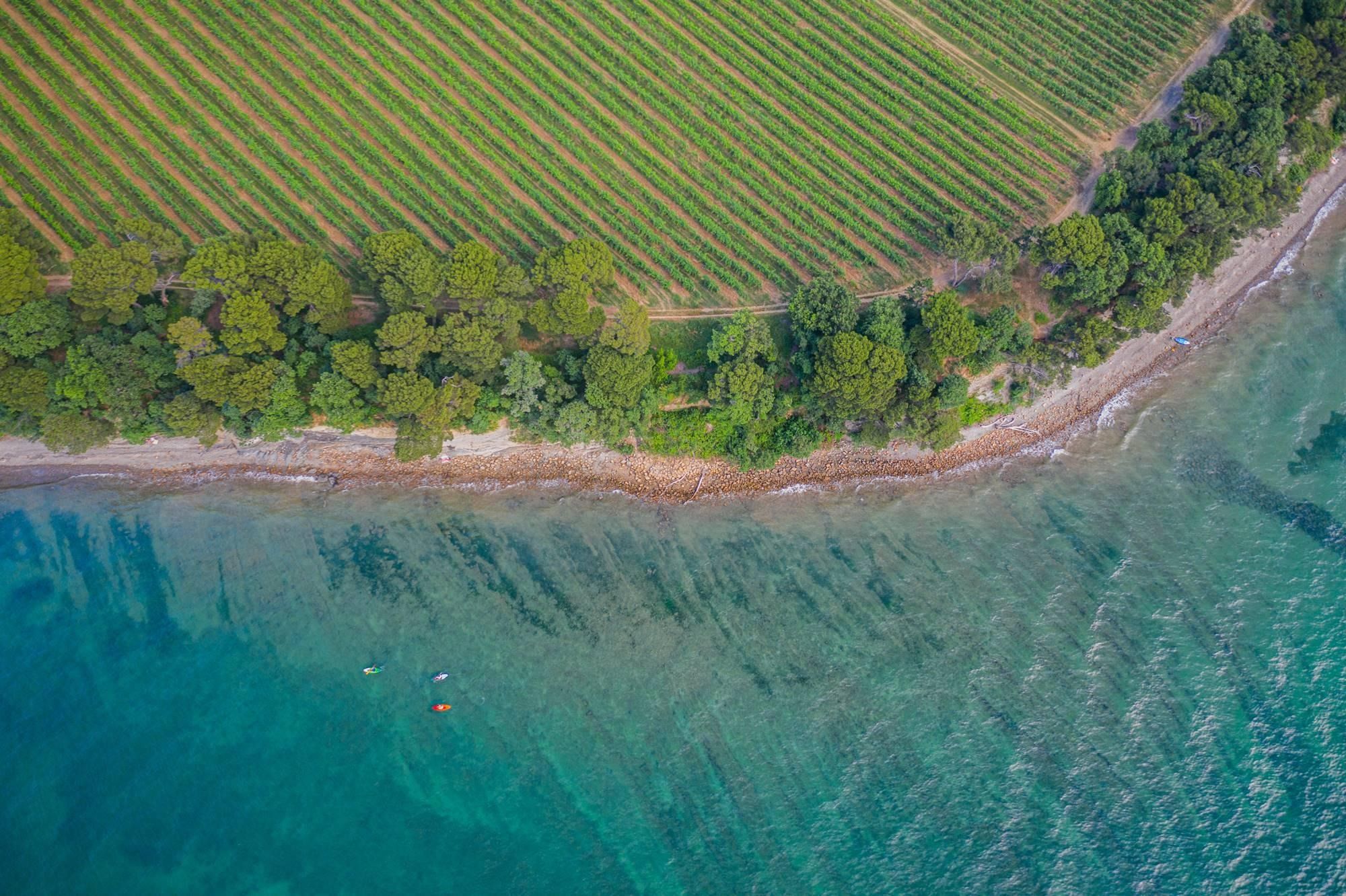
The most sunlit and the warmest Slovenian wine-growing district, Slovenian Istria, is located by the Adriatic Sea between Italy and Croatia. Vineyards extend from an altitude of 250 m all the way to the coast. Istria’s climate is mild Mediterranean. Precipitation on the coast is between 900 and 1,00 mm, and up to 1,300 mm inland. The soil is composed of flysch which contains layers of sandstone and marl.
The most represented variety is the red variety of Refosco, which covers over 45 per cent of all vineyards. Refosco produces wine deep violet in colour, with full to medium body, high acidity, and the characteristic flavours of red and black fruits, and spicy notes. International varieties of Cabernet Sauvignon and Merlot, and lately Syrah also thrive.
The most important white variety is Istrian Malvasia planted in over 30 per cent of vineyards. This aromatic variety low or moderate in acidity, and with characteristic acacia and yellow fruit flavours will be the ideal pairing for a seafood plate in the summer months. Certain producers age Malvasia in wood or produce orange wine with longer skin maceration. In addition to Malvasia, Chardonnay, Pinot Gris, and Yellow Muscat are also grown in Istria.
Slovenian Istra
Photo: Jaka Ivančič